
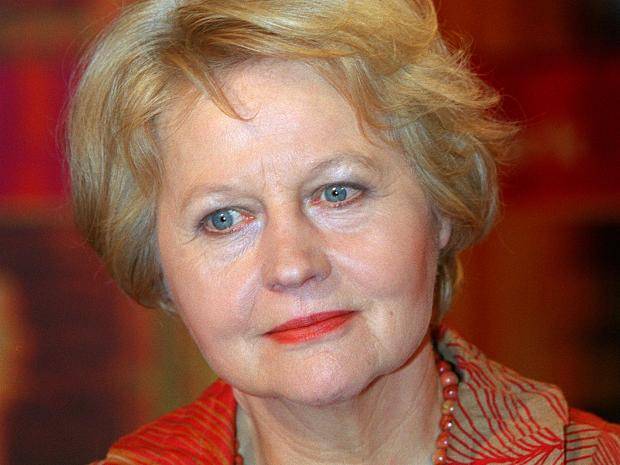
The historian Brigitte Hamann (Essen 1940 – Vienna 2016) will be remembered as one of the most successful German-Austrian historians. She enjoyed recognition from both the academic world of history and the general public, making her an exceptional figure among independent historians. In her books, particularly in ‘Hitler’s Vienna’, she combined academic precision with a rare ability to tell history in a captivating way.
Brigitte Hamann, who once said of her German origins: ‘I had a different view of Austria and began to write with a certain distance,’ was awarded numerous prizes. She was a humanist and it was important to her to reach many people with her publications in order to trigger debates on a large scale and processes of reflection on a small scale.
Brigitte Hamann will be remembered as one of the most successful historians in the German-speaking world. She made a valuable contribution to historical research.
In 1978, she obtained her doctorate with a dissertation on the Austrian Crown Prince Rudolf. In the same year, she published his biography under the title Rudolf. Crown Prince and Rebel. The book was a great success.
Since completing her doctorate, Brigitte Hamann has worked as a freelance historian. Together with her husband, she developed her own method of scientifically researching popular historical topics on the basis of intensive archival work and communicating them to a wider audience in language that is easy to understand.
Hamann’s work mainly comprises monographs on historical topics. In Austria, she became particularly popular for her books on the Habsburgs. Her best-known biography is probably the one about Empress Elisabeth (Elisabeth, Kaiserin wider Willen). This book was published in 1981 and translated into Italian, French, English, Spanish and Hungarian, selling 100,000 copies in Hungary alone.
She also wrote about Mozart, the Wagner family, and Bertha von Suttner, and published various historical documents, such as the correspondence between Emperor Franz Joseph and Katharina Schratt and the partly secret writings of Crown Prince Rudolf. She also wrote children’s books about Empress Maria Theresa and Mozart. Her biographical encyclopedia “Die Habsburger” (The Habsburgs), published in 1988, is considered a standard work.
Works (selection)
Rudolf, Crown Prince and Rebel, 1978
Elisabeth, Empress Against Her Will, 1981
Bertha von Suttner, A Life for Peace, 1986
The Habsburgs, Biographical Lexicon (ed.), 1988
Nothing but Music in His Head. The Life of Wolfgang Amadeus Mozart (children’s book), 1990
My Dear, Good Friend. The Letters of Emperor Franz Joseph to K. Schratt (ed.), 1992
Elisabeth. Images of an Empress, 1995
Hitler’s Vienna. The Apprenticeship of a Dictator, 1996
The First World War: Truth and Lies in Pictures and Texts, 2002
Winifred Wagner or Hitler’s Bayreuth, 2002
The Wagner Family, 2005
Crown Prince Rudolf. A Life, 2005
One Heart and Many Crowns. The Life of Empress Maria Theresa (children’s book, ill. by R. Rettich), 2004
Mozart. His Life and Times, 2006
Hitler’s Noble Jew. The Life of the Poor Doctor Eduard Bloch, 2008
Austria. A Historical Portrait, 2009
Awards and honours (selection)
Heinrich Drimmel Prize, 1978
Premio Comisso, 1982
DANUBIUS Donauland Non-Fiction Prize, 1986
Anton Wildgans Prize, 1995
Bruno Kreisky Prize for Political Books, 1998
‘Book of the Year 2002’ for ‘Winifred Wagner oder Hitlers Bayreuth’ (awarded by Opernwelt magazine), 2002
‘Book of the Year 2002’ also for ‘Winifred Wagner oder Hitlers Bayreuth’ (awarded by Damals magazine), 2002
Honorary Award of the Concordia Press Club, 2002
Award of the City of Vienna for Journalism, 2004
Silver Medal of Honour of the Federal Capital Vienna, 2006
Honorary Award of the Austrian Book Trade for Tolerance in Thought and Action, 2012